Geometry formulas PDFs offer a convenient, portable resource for students and professionals alike, consolidating essential math formulas and geometric shapes.
These readily available documents, like those from Scribd India and Mater Academy Charter Middle, streamline problem-solving and learning;
What is Geometry?
Geometry, at its core, is the branch of mathematics concerned with the properties and relations of points, lines, surfaces, solids, and higher dimensional analogs.
It’s a visual and spatial discipline, exploring shapes, sizes, relative position of figures, and the properties of space.
Understanding geometry is fundamental to many fields, from architecture and engineering to art and computer graphics.
Resources like geometry formula sheets (available as PDFs from sources like Mater Academy Charter Middle) provide a concise overview of key concepts.
These sheets encapsulate essential geometric formulas, aiding in calculations for area, perimeter, volume, and more;
Essentially, geometry provides the tools to analyze and describe the physical world around us.
Why Use a Geometry Formulas PDF?
A geometry formulas PDF offers unparalleled convenience and accessibility; Unlike flipping through textbooks, a PDF consolidates all essential formulas in one easily searchable document.
These PDFs, like those found on Scribd India, are portable – accessible on smartphones, tablets, or computers, making them ideal for studying on the go.
They eliminate the need for constant internet access, ensuring you always have the information you need.
Furthermore, PDFs often include diagrams and visual aids, enhancing understanding.
Resources from Mater Academy Charter Middle demonstrate how these sheets serve as quick reference guides during exams or problem-solving.
Ultimately, a geometry formula PDF streamlines learning and boosts efficiency.
Basic 2D Shapes Formulas
Geometry formula sheets, readily available as PDFs, provide quick access to essential calculations for triangles, quadrilaterals, and circles – foundational geometric concepts.
Triangle Formulas
Geometry formula sheets, often found as downloadable PDFs, are invaluable resources for tackling triangle-related problems. These sheets consolidate the key equations needed for various calculations.
Understanding these formulas is crucial for success in geometry. The area of a triangle is commonly calculated using the formula: 1/2 * base * height. This fundamental equation allows for determining the space enclosed within the triangle’s boundaries.
Furthermore, the perimeter of a triangle, representing the total length of its sides, is simply the sum of the lengths of all three sides: a + b + c. These formulas, readily accessible in PDF format, empower students and professionals to efficiently solve a wide range of triangular problems.
Area of a Triangle
Determining the area of a triangle is a foundational skill in geometry, and geometry formula sheets, frequently available as PDFs, provide quick access to the necessary equation. The most common formula calculates area as one-half multiplied by the base and the height: Area = 1/2 * base * height.
This formula represents the space enclosed within the triangle’s boundaries. The ‘base’ can be any side of the triangle, but the ‘height’ must be the perpendicular distance from that base to the opposite vertex.
PDF resources often illustrate this concept visually, aiding comprehension. Mastering this formula, readily found in downloadable geometry formula PDFs, is essential for solving numerous geometric problems and real-world applications.
Perimeter of a Triangle
Calculating the perimeter of a triangle, representing the total length of its sides, is a fundamental concept in geometry. Geometry formula sheets, often distributed as convenient PDFs, clearly state the formula: Perimeter = side1 + side2 + side3.
This simple equation involves adding the lengths of all three sides of the triangle. Understanding perimeter is crucial for various applications, from fencing a triangular garden to determining the amount of material needed for a triangular structure.
These geometry formula PDFs frequently include diagrams to visually reinforce the concept. Quick access to this formula, via downloadable resources, streamlines problem-solving and enhances geometric understanding for students and professionals alike.
Quadrilateral Formulas
Quadrilaterals, polygons with four sides, encompass various shapes like squares, rectangles, parallelograms, and trapezoids. Geometry formula PDFs provide a consolidated resource for calculating their perimeters and areas. These sheets, such as those found as downloadable resources, are invaluable for students and professionals.
Understanding the specific formulas for each quadrilateral is key. For instance, a square and rectangle’s perimeter is 2(length + width), while a parallelogram requires knowing base and height. These PDFs often present formulas alongside illustrative diagrams.
Accessing these geometry formulas in PDF format allows for quick reference during problem-solving, ensuring accuracy and efficiency in geometric calculations. They simplify complex concepts.
Square Formulas
A square, a special type of quadrilateral, possesses four equal sides and four right angles. Geometry formula PDFs consistently feature dedicated sections for square calculations, simplifying geometric problem-solving. These resources, often available as downloadable sheets, provide quick access to essential formulas.
The area of a square is calculated by squaring the length of one side (Area = side2). Similarly, the perimeter of a square is found by multiplying the side length by four (Perimeter = 4 * side).
These formulas are fundamental in various applications, and a well-organized PDF ensures students and professionals can readily apply them. Utilizing these PDFs streamlines calculations and reinforces understanding of square properties.
Area of a Square
Determining the area of a square is a foundational concept in geometry, frequently detailed within geometry formula PDFs. These PDFs serve as concise references, offering immediate access to the necessary equation. Understanding this calculation is crucial for various applications, from calculating room dimensions to solving complex geometric problems.
The formula for the area of a square is remarkably simple: Area = side2. This means you multiply the length of one side of the square by itself.
Numerous online resources and downloadable sheets, like those found on Scribd, emphasize this formula. Mastering this calculation, aided by a readily available PDF, builds a strong base for more advanced geometric concepts.
Perimeter of a Square
Calculating the perimeter of a square is another fundamental skill in geometry, consistently highlighted in accessible geometry formula PDFs. These PDFs act as quick guides, providing the essential equation for easy reference. Grasping this concept is vital for practical applications, such as fencing a garden or framing a picture.
The formula for the perimeter of a square is straightforward: Perimeter = 4 * side. This means you multiply the length of one side of the square by four, as all sides are equal in length.
Various online resources and downloadable sheets, including those from educational institutions, reinforce this formula. Utilizing a geometry formula PDF simplifies this calculation and strengthens foundational geometric understanding.
Rectangle Formulas
Rectangle formulas are cornerstones of basic geometry, frequently included in comprehensive geometry formula PDFs designed for students and professionals. These PDFs consolidate the essential equations for calculating both area and perimeter, offering a convenient reference point for problem-solving. Understanding rectangles is crucial, as they appear in numerous real-world applications, from architecture to everyday design.
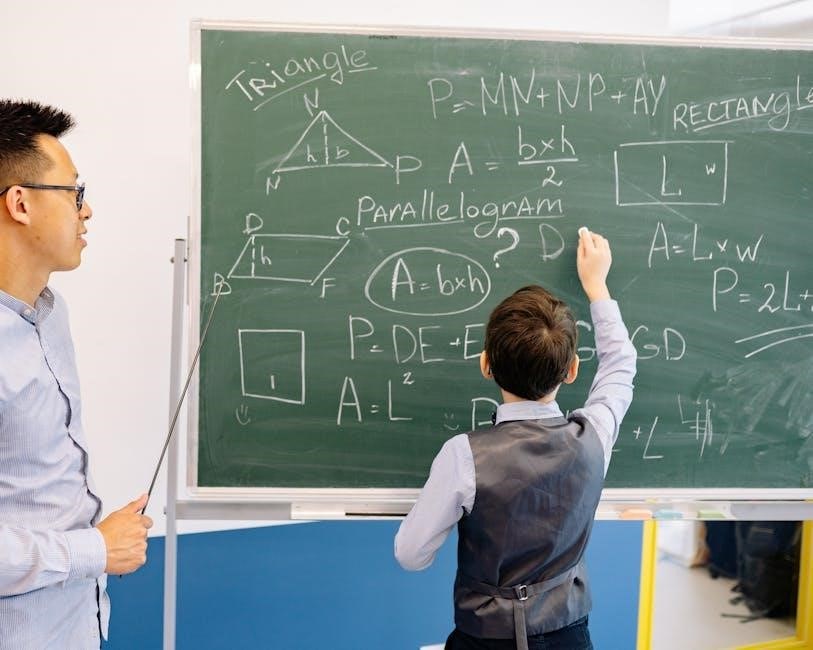
These resources, like the geometry formula sheet versions available online, clearly present the formulas. The perimeter is calculated as P = 2(l + w), where ‘l’ represents length and ‘w’ represents width. This means adding the length and width together, then multiplying by two.
Accessing a geometry formula PDF streamlines learning and reinforces these fundamental concepts.
Area of a Rectangle
Determining the area of a rectangle is a foundational skill in geometry, and readily accessible within any comprehensive geometry formulas PDF. These PDFs serve as invaluable resources for students and professionals alike, providing a quick reference for essential calculations. The formula itself is remarkably straightforward: Area (A) = Length (l) x Width (w).
This means multiplying the length of the rectangle by its width to find the space enclosed within its boundaries. Numerous online geometry formula sheets, such as those found on various educational websites, clearly illustrate this concept.
Understanding this formula is crucial for solving a wide range of geometric problems and real-world applications, making a geometry formulas PDF an indispensable tool.
Perimeter of a Rectangle
Calculating the perimeter of a rectangle is another fundamental geometric concept, conveniently outlined in most geometry formulas PDF resources. These PDFs are designed to be easily accessible study aids, offering a concise compilation of essential formulas. The perimeter, representing the total distance around the rectangle, is determined by the formula: Perimeter (P) = 2(Length (l) + Width (w)).
Essentially, you add the lengths of all four sides together – or, more efficiently, double the sum of the length and width. Geometric formula sheets, often available for free download, consistently present this formula for quick reference.
Mastering this calculation is vital for various applications, solidifying the importance of a readily available geometry formulas PDF.
Parallelogram Formulas
Parallelogram formulas are crucial components within any comprehensive geometry formulas PDF, providing the tools to analyze these four-sided shapes. A geometric formula sheet will typically detail both area and perimeter calculations. The area of a parallelogram is calculated using the formula: Area = base × height, where the height is the perpendicular distance between the base and its opposite side.
Determining the perimeter of a parallelogram is straightforward, mirroring that of rectangles: Perimeter = 2(side1 + side2), as opposite sides are equal in length. These formulas, readily found in downloadable PDFs, are essential for students and professionals alike.
Having these formulas at your fingertips, via a geometry formulas PDF, simplifies complex geometric problems.
Area of a Parallelogram
Calculating the area of a parallelogram is a fundamental skill detailed in most geometry formulas PDF resources. Unlike rectangles, parallelograms don’t necessarily have right angles, necessitating a specific formula. The core principle revolves around the base and height, but it’s crucial to remember the height must be perpendicular to the base.
The formula is elegantly simple: Area = base × height. A geometric formula sheet will consistently present this. Understanding this formula is vital for solving problems involving land surveying, architectural design, and various engineering applications.
Many online resources and downloadable PDFs, like those available on Scribd, emphasize this calculation as a cornerstone of parallelogram analysis. Mastering this ensures accurate area determination.
Perimeter of a Parallelogram
Determining the perimeter of a parallelogram is straightforward and frequently covered in geometry formulas PDF guides. Unlike area, which requires height, perimeter only considers the lengths of the sides. A parallelogram, by definition, has opposite sides that are equal in length. Therefore, calculating the perimeter involves simply adding up the lengths of all four sides;
The formula is expressed as: Perimeter = 2 × (side1 + side2). A comprehensive geometric formula sheet will always include this. This is because you only need to know the lengths of two adjacent sides to calculate the total perimeter.
Resources like those found on Scribd and within school materials emphasize this simple addition as a key parallelogram property. Accurate perimeter calculation is essential in fencing and framing applications.
Trapezoid Formulas
Trapezoid formulas are essential components of any comprehensive geometry formulas PDF, addressing both area and perimeter calculations. A trapezoid is a quadrilateral with at least one pair of parallel sides – these are known as the bases. Understanding these formulas is crucial for various mathematical applications.
A geometric formula sheet will detail that the perimeter is found by summing all four sides: Perimeter = side1 + side2 + side3 + side4. However, the area calculation is more complex; It’s calculated as: Area = ½ × (base1 + base2) × height.
Resources like those available online and in educational materials consistently highlight the importance of correctly identifying the bases and height when calculating the area. These formulas are frequently used in surveying and architectural design.
Area of a Trapezoid
Determining the area of a trapezoid is a fundamental skill detailed within any useful geometry formulas PDF. The trapezoid, defined by at least one pair of parallel sides (bases), requires a specific formula for accurate calculation. Unlike simpler shapes, its area isn’t simply length times width.
The formula is: Area = ½ × (base1 + base2) × height. Crucially, ‘height’ represents the perpendicular distance between the two bases, not the length of the non-parallel sides. A geometric formula sheet will emphasize this distinction.
Many online resources and educational materials, like those found on Scribd, reinforce this formula. Correctly identifying the bases and height is paramount for accurate results, making this formula a key element in any geometry toolkit.
Perimeter of a Trapezoid
Calculating the perimeter of a trapezoid, as outlined in comprehensive geometry formulas PDFs, is a straightforward process, yet requires careful attention to detail. Unlike area, which focuses on the two-dimensional space within, perimeter concerns the total length around the shape’s exterior.
The formula is simply: Perimeter = side1 + side2 + base1 + base2. This means adding the lengths of all four sides of the trapezoid together. A reliable geometric formula sheet will clearly present this addition-based formula.
Resources like those available online emphasize that accurate measurement of each side is crucial. Understanding this basic principle, readily available in downloadable PDFs, is fundamental to mastering trapezoid properties and solving related geometric problems.
Circle Formulas
Geometry formulas PDFs provide essential equations for circles, including area and circumference calculations. These resources simplify complex concepts for students and professionals.
Area of a Circle
Geometry formulas PDFs consistently present the area of a circle as πr², where ‘π’ (pi) is a mathematical constant approximately equal to 3.14159, and ‘r’ represents the radius of the circle.
Understanding this formula is fundamental in various mathematical applications, from calculating the surface area of circular objects to solving problems in trigonometry and calculus.
These PDFs often visually demonstrate the formula, aiding comprehension. Resources like those found on various educational websites and school handouts emphasize the importance of correctly identifying the radius before applying the formula.
Accurate calculation of a circle’s area relies on precise measurement of its radius, making it a core concept within geometry formula sheets.
Circumference of a Circle
Geometry formulas PDFs universally define the circumference of a circle as 2πr, where ‘π’ (pi) is approximately 3.14159 and ‘r’ denotes the radius. Alternatively, it’s expressed as πd, utilizing the diameter (‘d’) which is twice the radius.

These resources highlight that circumference represents the total distance around the circle’s perimeter; Mastering this formula is crucial for applications like calculating wheel rotations or determining the length of circular paths.
Many geometry formula sheets include diagrams illustrating the relationship between radius, diameter, and circumference, enhancing understanding.
Consistent presentation across various PDFs ensures students and professionals have a reliable reference for this fundamental geometric calculation.

3D Shapes Formulas
Geometry formulas PDFs extend beyond 2D, providing essential calculations for volume and surface area of 3D shapes like cubes, spheres, and cylinders.
Cube Formulas
Geometry formulas PDFs are invaluable when tackling three-dimensional shapes, and the cube is a fundamental example. Understanding its formulas is crucial for various applications.
Volume of a Cube: The volume, representing the space enclosed within the cube, is calculated by cubing the length of one side (s). The formula is simply V = s3. A geometry formula sheet will clearly display this.
Surface Area of a Cube: A cube has six identical square faces. Therefore, the total surface area is found by multiplying the area of one face (s2) by six. The formula is SA = 6s2. Resources like those found online emphasize these core calculations.
These formulas, readily available in geometry formula resources, allow for quick and accurate determination of a cube’s volume and surface area.
Volume of a Cube
Determining the volume of a cube is a foundational skill in geometry, and geometry formulas PDFs provide a quick reference for the necessary equation. The volume represents the amount of three-dimensional space the cube occupies.
The formula for calculating the volume (V) of a cube is remarkably straightforward: V = s3, where ‘s’ represents the length of one side of the cube. This means you multiply the side length by itself three times.
Geometry formula sheets consistently highlight this formula due to its simplicity and frequent application in various mathematical problems. Understanding this concept is essential for more complex calculations involving 3D shapes.
Resources emphasize that accurate measurement of the side length is crucial for obtaining a correct volume calculation, as even slight errors can significantly impact the result.
Surface Area of a Cube
Calculating the surface area of a cube, often found within comprehensive geometry formulas PDFs, involves determining the total area covering all its faces. A cube possesses six identical square faces, making the calculation relatively simple once the formula is understood.
The formula for the surface area (SA) of a cube is SA = 6s2, where ‘s’ denotes the length of one side. This means you square the side length and then multiply the result by six, representing the six faces.
Geometry formula sheets consistently present this equation as a core concept in solid geometry. Mastering this calculation is vital for problems involving material usage or external coatings.
Accurate side length measurement remains paramount, as the surface area is directly proportional to the square of the side, meaning even small errors are amplified in the final result.
Sphere Formulas
Geometry formulas PDFs consistently feature formulas for spheres, a fundamental 3D shape. Understanding these formulas is crucial for calculations involving volume and surface area, frequently encountered in physics and engineering applications.
The volume (V) of a sphere is calculated using the formula V = (4/3)πr3, where ‘r’ represents the sphere’s radius. This formula demonstrates the proportional relationship between volume and the cube of the radius.
The surface area (SA) is determined by SA = 4πr2. This indicates the surface area grows with the square of the radius. These formulas are often presented together on geometry formula sheets for easy reference.
Remembering the constants – 4/3 and 4 – alongside π is key to accurate calculations. These formulas are essential components of any solid geometry toolkit.
Volume of a Sphere
Geometry formulas PDFs universally include the formula for calculating the volume of a sphere, a cornerstone of 3D geometry. This formula, V = (4/3)πr3, is essential for determining the amount of space a sphere occupies.
Here, ‘V’ denotes volume, ‘π’ (pi) is a mathematical constant approximately equal to 3.14159, and ‘r’ represents the sphere’s radius – the distance from the center to any point on its surface.
The formula highlights that volume increases cubically with the radius; doubling the radius increases the volume by a factor of eight. Geometric formula sheets often emphasize this relationship.
Accurate calculation requires careful attention to the order of operations (radius cubed first, then multiplied by 4/3 and π). Mastering this formula is vital for solving various problems in mathematics and related fields.

Surface Area of a Sphere
Geometry formulas PDFs consistently present the formula for a sphere’s surface area, a crucial element in 3D geometric calculations. The formula, 4πr2, determines the total area covering the sphere’s outer surface.
In this equation, ‘π’ (pi) remains the mathematical constant approximately equal to 3.14159, and ‘r’ signifies the sphere’s radius. Unlike volume, surface area increases with the square of the radius; doubling the radius quadruples the surface area.
Geometric formula sheets often visually demonstrate this relationship. Understanding this formula is key for applications like calculating material needed to coat a spherical object.
Correct application demands precise radius measurement and adherence to the order of operations (radius squared first, then multiplied by 4 and π). This formula is fundamental across diverse scientific and engineering disciplines.

Cylinder Formulas
Geometry formulas PDFs dedicate sections to cylinders, essential 3D shapes found in numerous real-world applications. These resources detail both volume and surface area calculations, vital for engineering and design.
The volume of a cylinder is calculated using πr2h, where ‘r’ represents the radius of the circular base and ‘h’ is the cylinder’s height. Surface area, however, requires two calculations: the area of the two circular bases (2πr2) and the lateral surface area (2πrh).
Adding these together (2πr2 + 2πrh) provides the total surface area. Geometric formula sheets often include diagrams to clarify these components.
Mastering these formulas is crucial for determining capacity, material requirements, and structural integrity in various contexts, from storage tanks to architectural designs. Accurate measurements of radius and height are paramount for precise results.
Volume of a Cylinder
Geometry formulas PDFs consistently present the volume of a cylinder as a fundamental calculation in three-dimensional geometry. Understanding this formula is crucial for determining the capacity of cylindrical containers and solving related problems.
The formula itself is expressed as V = πr2h, where ‘V’ denotes volume, ‘π’ (pi) is approximately 3.14159, ‘r’ represents the radius of the circular base, and ‘h’ signifies the height of the cylinder.
Essentially, you calculate the area of the base (πr2) and then multiply it by the height. Geometric formula sheets often visually demonstrate this concept.
Accurate measurement of both the radius and height is essential for obtaining a precise volume calculation. This formula finds applications in diverse fields, including engineering, architecture, and everyday problem-solving.
Surface Area of a Cylinder
Geometry formulas PDFs detail the surface area of a cylinder as encompassing both the curved surface and the two circular bases. Calculating this requires understanding the components and applying the correct formula.
The complete formula is 2πrh + 2πr2, where ‘r’ is the radius and ‘h’ is the height. The 2πrh portion calculates the lateral surface area (the curved side), while 2πr2 calculates the combined area of the two circular bases.
Geometric formula sheets often break down this calculation for clarity. Accurate measurement of both radius and height is vital for precise results.
This calculation is essential in scenarios requiring material estimation for cylindrical objects, like determining the amount of paint needed or the material required for manufacturing. Mastering this formula is key to solving real-world problems.
Coordinate Geometry Formulas
Geometry formulas PDFs include coordinate geometry, vital for plotting points and analyzing shapes on a plane using coordinates.
Resources showcase formulas like the distance and midpoint formulas.
Distance Formula
Geometry formulas PDFs consistently feature the distance formula as a cornerstone of coordinate geometry. This crucial formula calculates the distance between two points in a coordinate plane, denoted as (x1, y1) and (x2, y2).
The formula itself is expressed as:
d = √[(x2 ⏤ x1)2 + (y2 ⏤ y1)2]
Where ‘d’ represents the distance between the two points. Understanding this formula, readily available in resources like those found through stock illustration searches, is fundamental for solving a wide range of geometric problems. It’s a key component in many geometry formula sheets, ensuring students have quick access to this essential tool for spatial calculations and analysis.
Its application extends to various fields beyond pure mathematics.
Midpoint Formula
Geometry formulas PDFs invariably include the midpoint formula, a vital tool in coordinate geometry for determining the central point between two given points. Given two points, (x1, y1) and (x2, y2), the midpoint is calculated using the following formula:
Midpoint = ((x1 + x2)/2 , (y1 + y2)/2)
This formula effectively finds the average of the x-coordinates and the average of the y-coordinates. Resources like comprehensive geometry formula sheets, often available as downloadable PDFs, present this formula clearly.
Its utility extends beyond theoretical calculations; it’s used in various applications, including computer graphics and spatial analysis. Mastering this, alongside the distance formula, is crucial for success in coordinate geometry, as highlighted in many educational materials and online resources.
